 Sterling Bond
You will identify how chronic hip, knee, or back stiffness shrinks the territory of shared partner leisure. You will establish a twenty-minute joint mobility routine that preserves daily freedom of movement.

- Unaddressed joint stiffness gradually eliminates shared walks, travel, and spontaneous intimacy.
- Consistent low-load range-of-motion work lubricates cartilage more effectively than total rest.
- Small ergonomic adjustments in the home relieve daily aches and boost evening vitality.
When we work with dense timber or vegetable-tanned leather, we learn quickly that dry fibers do not bend. They check, splinter, and bind under tension. The human musculoskeletal frame follows an identical mechanical logic. Ligaments, articular cartilage, and fascial sheaths are living materials that demand continuous hydration, warmth, and deliberate shearing forces to retain their glide. When joint surfaces lose their smooth articulation, the physical perimeter of a household begins to contract. What starts as a dull ache in the lumbar spine or a pinch in the anterior hip slowly dictates how we rise from a low bench, how far we travel on foot, and how we settle into rest at the end of the day.
In a shared domestic life, this physical contraction rarely stays isolated within a single body. Physical habits between partners develop around the least mobile joint in the room. We begin to sit longer, walk shorter routes, and substitute active touch with cautious stillness. Restoring physical ease requires us to treat the body not as an abstract machine that has broken down, but as a responsive structure that requires daily tuning, mechanical lubrication, and attentive joint care. By approaching joint health as a shared craft, we can dismantle the patterns of stiffness before they settle permanently into the frame.
The Compounding Effect of Musculoskeletal Restriction
Joint restriction functions like grit inside a bronze bushing: minor friction at a single pivot point quietly accelerates wear across the entire assembly. When an ankle joint loses five degrees of dorsiflexion, the knee must rotate abnormally to complete a single stride. That lateral twist transfers upward into the hip socket, tilting the pelvis forward and forcing the deep spinal extensors to lock into a continuous, low-grade spasm. Over months, this mechanical compensation dries out connective tissues, turning what was once pliable collagen into dense, disorganized adhesions that resist movement.
Synovial fluid, the thick fluid that nourishes articular cartilage, does not circulate through a dedicated pump like blood. It relies entirely on pressure differentials created by movement. When we compress a joint through its complete arc and then unload it, we force metabolic waste out of the cartilage matrix and draw fresh nutrients inward. A joint kept motionless inside a twenty-degree range of motion effectively starves its deepest layers of tissue. Over years, the cartilage thins, the joint capsule tightens like shrunk canvas, and the nervous system recalibrates its baseline, registering standard movements as threats and triggering protective muscular guarding.
This guarding creates a quiet feedback loop. The brain detects localized inflammation, stiffens the surrounding musculature to splint the region, and thereby further reduces synovial exchange. The tissue becomes acidic and fibrous. Breaking this cascade does not require aggressive force; it requires controlled, unhurried loading that signals safety to the mechanoreceptors embedded deep inside the joint capsules.
How Lingering Discomfort Dampens Relational Spontaneity
Chronic musculoskeletal tightness alters physical presence long before it generates acute, sharp pain. When an individual lives with persistent lumbar compression or restricted sacroiliac joints, their nervous system remains in a sustained state of sympathetic readiness. Touch ceases to register purely as comfort; instead, unexpected physical contact triggers micro-flinches, as the body instinctively shields vulnerable pivots. Over time, a partner learns not to drape an arm across a shoulder or lean into a hip while standing at the kitchen counter, wary of provoking an involuntary wince.
This subtle defensiveness dampens daily intimacy. Spontaneous affection requires an underlying assumption of structural ease. When every shift from the sofa requires calculating spinal angles, or when kneeling on the floor to pick up dropped tools feels costly, the rhythm of physical cooperation falters. One partner becomes the cautious caregiver or the careful bystander, while the other retreats into physical stoicism, reluctant to voice the constant background hum of joint fatigue.
Acknowledging this tension openly changes the dynamic. Rather than treating stiffness as an unmentionable decline, we can treat it as a shared mechanical problem that deserves workspace and dedicated practice. When both people understand the exact physical thresholds of an joint mobility knee or a tight shoulder, physical touch can shed its ambiguity and return to being a source of mutual regulation and comfort.
A Daily Morning Flow for Hips, Spine, and Ankles
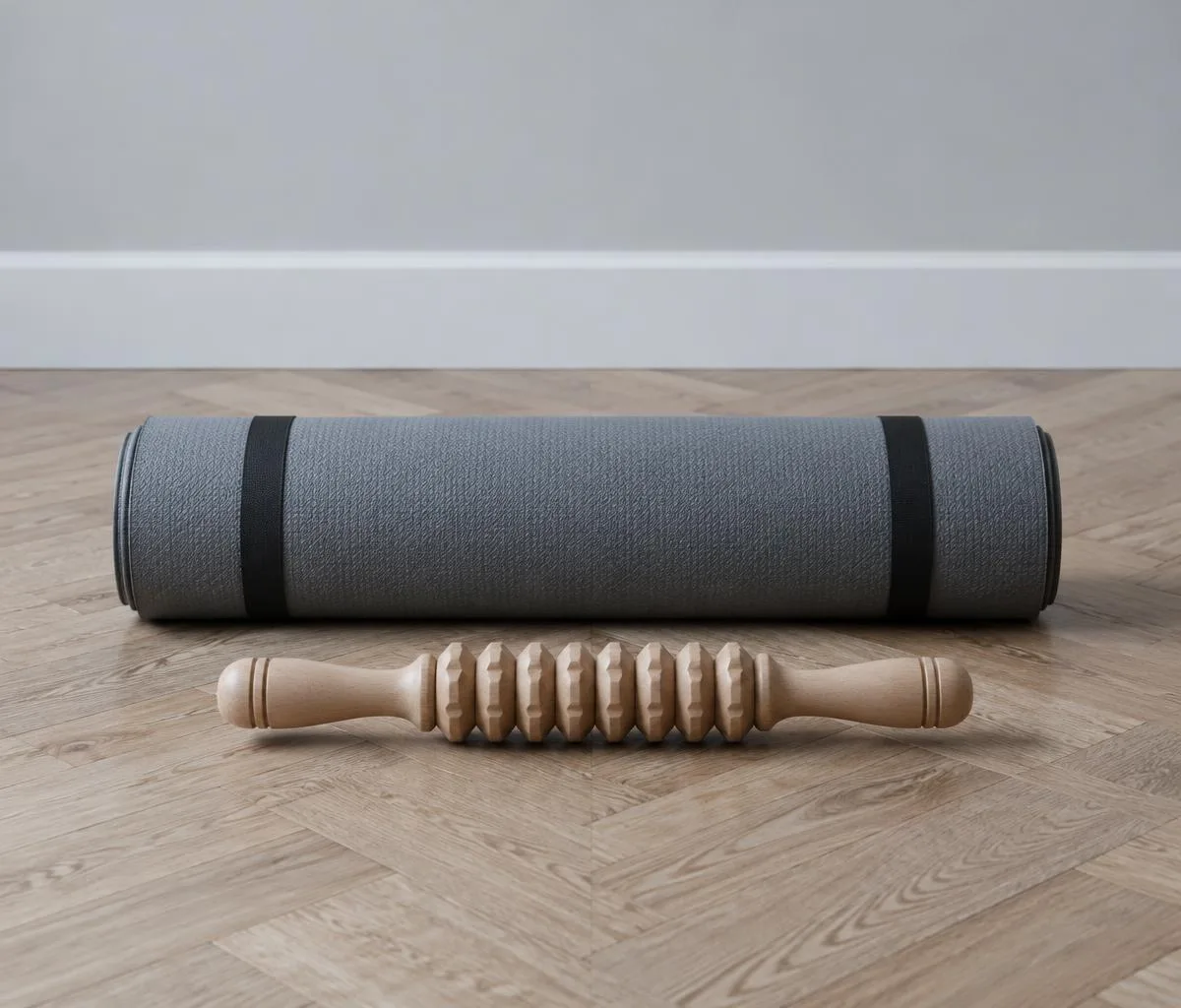
We begin on a firm, warm surface. A wool rug over oak or a dense rubber mat provides sufficient resistance without bruising bony prominences. Soft mattresses dissipate force and prevent the stabilization needed to isolate deep joints. Move through this sequence slowly, timing movements with the breath, spending roughly six to eight minutes in total.
- Controlled Ankle Rotations: Sit upright on the floor with your back supported by a wall, legs extended. Draw one knee toward the chest, clasping your hands behind the thigh to immobilize the shin. Slowly trace the largest possible circle with the toes. Spend six seconds per revolution, feeling the tendons across the front of the ankle pull taut before shifting the tension to the peroneal muscles along the outer calf. Perform five deliberate circles clockwise and five counterclockwise on each side.
- The Pelvic Clock: Lie flat on your back with knees bent at a ninety-degree angle and the soles of your feet planted flat on the floor, hip-width apart. Imagine your sacrum resting on the face of a clock. Inhale and gently arch your lower back, rolling your pelvis toward the tailbone (six o'clock). Exhale and flatten your lumbar spine firmly into the floor, tilting your pubic bone toward your navel (twelve o'clock). Shift slowly between these two poles for eight repetitions, smoothing out any jerky hesitations along the movement arc.
- Segmental Spinal Articulation: Roll onto hands and knees, placing wrists directly beneath shoulders and knees beneath hip sockets. Spread your fingers wide, gripping the floor like raw canvas. Beginning strictly at the base of the spine, tuck the tailbone under, then round the lumbar spine vertebrae by vertebrae, followed by the thoracic cage, and finally drop the head between the arms. Reverse the sequence from the neck down, lifting the chin last. Perform six full passes, isolating each mechanical segment.
- Supported Low Squat Prying: Stand facing a sturdy table or doorframe. Grasp the edge with both hands, place your feet slightly wider than your shoulders with toes angled out thirty degrees, and lower your hips toward your heels. Use your hands to offset your body weight, allowing your hips to sink between your calves without rounding your lower back. Gently shift your weight from the left heel to the right heel for forty-five seconds, encouraging the hip capsules to expand and the Achilles tendons to lengthen under passive load.
Adjusting Intimate Positions to Accommodate Stiff Joints
Physical closeness should never demand that a joint sit at the extreme end of its range under load. When joint mobility, hip impingement, or disc compressions are present, standard positions place destructive shearing forces across unpadded bones. By introducing firm props, such as high-density foam wedges, cylindrical buckwheat bolsters, or tightly rolled wool blankets, we alter joint angles and redistribute pressure away from fragile cartilage.
| Challenged Joint | Standard Strain Point | Mechanical Modification | Primary Benefit |
|---|---|---|---|
| Lumbar Spine | Excessive extension or axial compression | Place a firm, low cushion under the pelvis; adopt a side-lying spooning configuration. | Maintains neutral lordosis; eliminates hyperextension under movement. |
| Anterior Hip / Labrum | Deep flexion beyond ninety degrees | Support the thighs with angled wedges; keep the knees slightly below the hip line. | Prevents femoral head impingement on the acetabular rim. |
| Patellofemoral Joint | Direct kneeling on firm surfaces | Adopt seated postures or place a thick, dense felt mat under the shins rather than knees. | Transfers weight to the tibial shaft, sparing the patella from direct compressive load. |
| Cervical Spine | Sustained neck flexion or rotation | Support the head and lateral neck with contoured memory foam to maintain horizontal alignment. | Relieves tension across the upper trapezius and suboccipital nerve pathways. |
Side-lying positions offer the greatest mechanical efficiency for stiff bodies. When both partners lie on their sides facing in the same direction, the spine remains in a neutral posture, the hips rest comfortably within a sixty-degree flexion arc, and the knees can be padded with a thin pillow between the inner condyles. This positioning eliminates the compressive gravitational load of one partner resting their weight entirely upon the other, turning intimate contact into a restorative, gentle state rather than a joint test.
Shared Walking Routines That Strengthen Connective Tissue
Walking is the definitive human movement pattern for maintaining connective tissue vitality, yet how and where we walk matters. Pounding concrete sidewalks at a variable, erratic pace often flares degenerative knee conditions. To condition joint capsules effectively, a walking routine should be deliberate, consistent, and performed across surfaces that offer a small degree of mechanical compliance.
We aim for twenty-five to thirty-five minutes of steady, continuous movement together, four to five days a week. Seek out packed dirt trails, crushed gravel tracks, or grass borders. These surfaces produce a microscopic dampening effect on heel strike while requiring the lateral stabilizers of the ankle and pelvis to engage constantly, adapting to slight ground variations. This subtle balance work draws blood into the deep stabilizing muscles of the hip, such as the gluteus medius and piriformis, which lie dormant during straight-line walking on paved surfaces.
Maintain an intentional cadence. Walk side by side at a pace that allows unhurried conversation, matching your strides where practical. Focus on the push-off phase: rather than merely throwing your legs forward and falling onto your heels, actively drive the ground behind you using the ball of your foot and the big toe. This engages the posterior chain, fires the hamstrings and glutes, and decompresses the anterior hip capsule with every stride. Walking together in this manner becomes an active mechanical reset, draining pooled fluid from lower extremities and flushing the spinal joints with fresh circulation.
Knowing When to Engage Physical Therapy Support
A committed home practice provides the daily maintenance required for structural longevity, but it cannot replace diagnostic clinical expertise when tissues suffer trauma or advanced degeneration. We must recognize the distinct physical markers that separate ordinary muscular tightness from pathology that requires licensed medical intervention.
Muscular tension typically feels broad, dull, and responsive to heat, movement, and gentle pressure. Pathological joint dysfunction behaves differently. You should seek an evaluation from a licensed physical therapist or orthopedic specialist if you or your partner encounter any of the following symptoms:
- Sharp, knife-like pain localized precisely to a joint line during movement or weight-bearing.
- Mechanical locking or catching, where a joint physically stops dead in its track and cannot be straightened without manual manipulation.
- Observable joint effusion, where a joint appears noticeably swollen, feels hot to the touch, or loses its bony definition.
- Radiating neurological symptoms, such as tingling, electrical numbness, or a sensation of sudden weakness that travels down an arm into the fingers or down a leg into the foot.
- Joint instability, where a hip, knee, or ankle gives way without warning during standard, level-ground walking.
A qualified physical therapist acts as a master builder for the frame. They assess structural asymmetries, identify whether a deficit stems from joint capsule restriction or neural inhibition, and prescribe targeted, progressive loading parameters. Approaching clinical care collaboratively allows both partners to learn the corrective exercises, ensuring the home environment accurately supports the rehabilitation program.
Common Mistakes to Avoid
- Forcing Through Sharp Pain: Assuming that joint pain should be worked through aggressively. While muscular burn can be tolerated, sharp or clicking pain signals structural irritation that will trigger deeper protective spasms.
- Passive Stretching of Cold Joints: Attempting deep, static hamstring or hip stretches first thing in the morning without prior movement. Cold connective tissue has low elasticity; loading it passively risks micro-tearing fascial sheaths.
- Over-Relying on Soft Furniture: Sinking into deep, pillowy sofas that curve the spine into extreme lumbar flexion. This slack posture creates severe ligamentous creep, making the act of standing upright painful and stiff.
- Asymmetrical Habits: Always walking on the same side of a partner, carrying loads on the identical shoulder, or resting one leg crossed over the other during dinner. These small domestic habits imprint deep asymmetries into the pelvis.
Building the Restorative Habit
Restoring physical ease is an iterative, daily craft. It does not require complex machinery or hour-long fitness sessions; it requires an attentive eye, honest communication about physical limits, and five to ten minutes of deliberate morning movement. Treat your shared physical environment with the same intentionality you would bring to a working studio: clear floor space, keep firm cushions near resting areas, and prioritize walking together before the day settles into inertia.
Begin tomorrow morning. Before clearing the breakfast table or turning to the day's tasks, step onto the floor together. Move through the ankle circles, find the quiet rhythm of the pelvic clock, and open the joint capsules with patience. By investing daily care into the material frame that carries you, you preserve the structural freedom and spontaneous ease that make living together deeply comfortable.
This publication provides educational context rather than clinical care: consult a licensed physician or therapist regarding individual symptoms. Disclaimer